Humanizing Addiction | NIH x NIDA
Location: Baltimore, Maryland
Dates: May 2018 – Aug 2018
Status: Completed
Quick Project Overview
As a summer research intern at the National Institute on Drug Abuse (NIDA) within the National Institutes of Health, I explored the neurobiological underpinnings of addiction. The project examined how nicotine and cocaine influence brain activity and the potential of transcranial magnetic stimulation (TMS) as a treatment tool.
-
This internship marked my earliest foray into neuroscience and behavioral health research. Motivated by a deep curiosity about the brain and human behavior, I joined NIDA to study addiction not only as a biological process but as a human and social phenomenon—particularly relevant to my hometown of Baltimore, where addiction is often tied to broader systemic inequities.
-
National Institute on Drug Abuse (NIDA)
National Institutes of Health (NIH)
-
Conducted data cleaning and analysis of EEG brainwave recordings to identify neural patterns associated with nicotine addiction
Assisted with and observed TMS sessions with participants self-identifying as cocaine users
-
Collected and streamlined EEG datasets for analysis
Supported ongoing trials testing the efficacy of TMS in mitigating addictive responses
Synthesized preliminary observations and contributed to data documentation for internal reporting
-
Organized and processed EEG data for inclusion in broader addiction studies
Contributed to internal research summaries and analysis frameworks used by the lab team
Final poster presentation on EEG data (pictured to the right)
-
Electroencephalography (EEG)
Transcranial Magnetic Stimulation (TMS)
MATLAB and lab-specific EEG analysis software
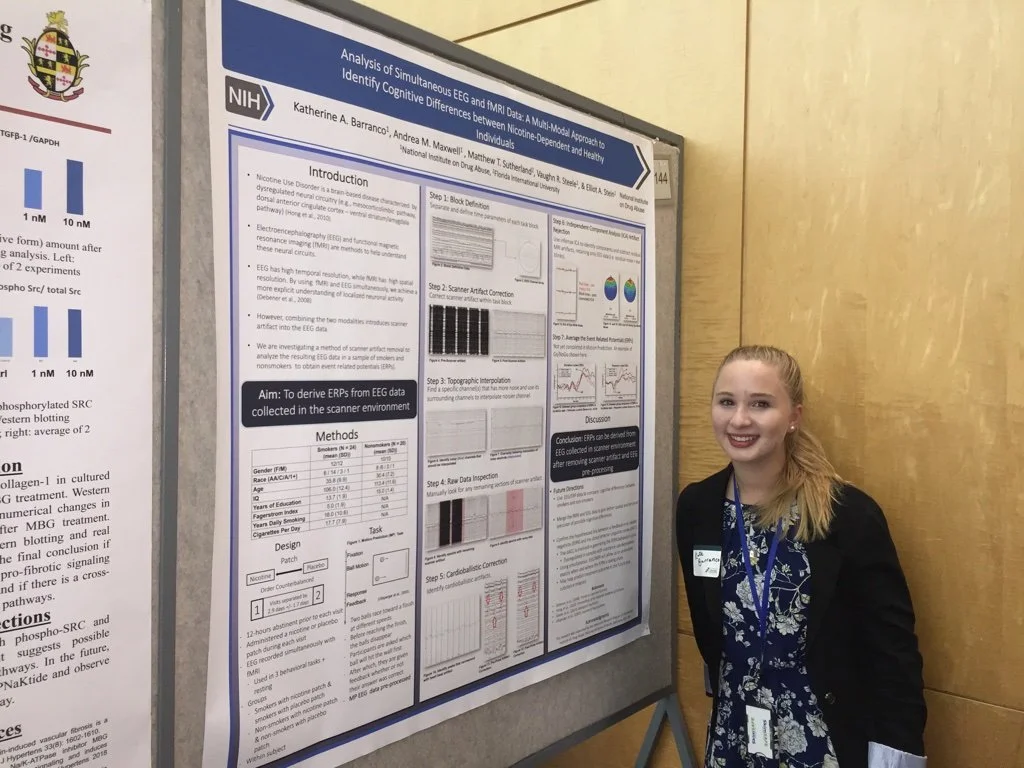
Poster Presentation Day 2018 NIDA Summer Research
Impact & Learnings
This experience fundamentally shaped how I understand systems of health and harm. Beyond neuroscience, it was my first window into how systemic issues like addiction intersect with community wellbeing and public health. It taught me that data can reveal patterns, but human stories bring depth—and that the two must coexist to drive meaningful change.